When you start learning salsa, you quickly hear two terms: Cuban salsa (also called Casino) and linear salsa (also known as Cross Body or LA style). But what exactly is the difference? And which style suits you best? In this article, we explain everything — from movement patterns to music, from origins to the atmosphere on the dance floor.
What is Cuban salsa (Casino)?
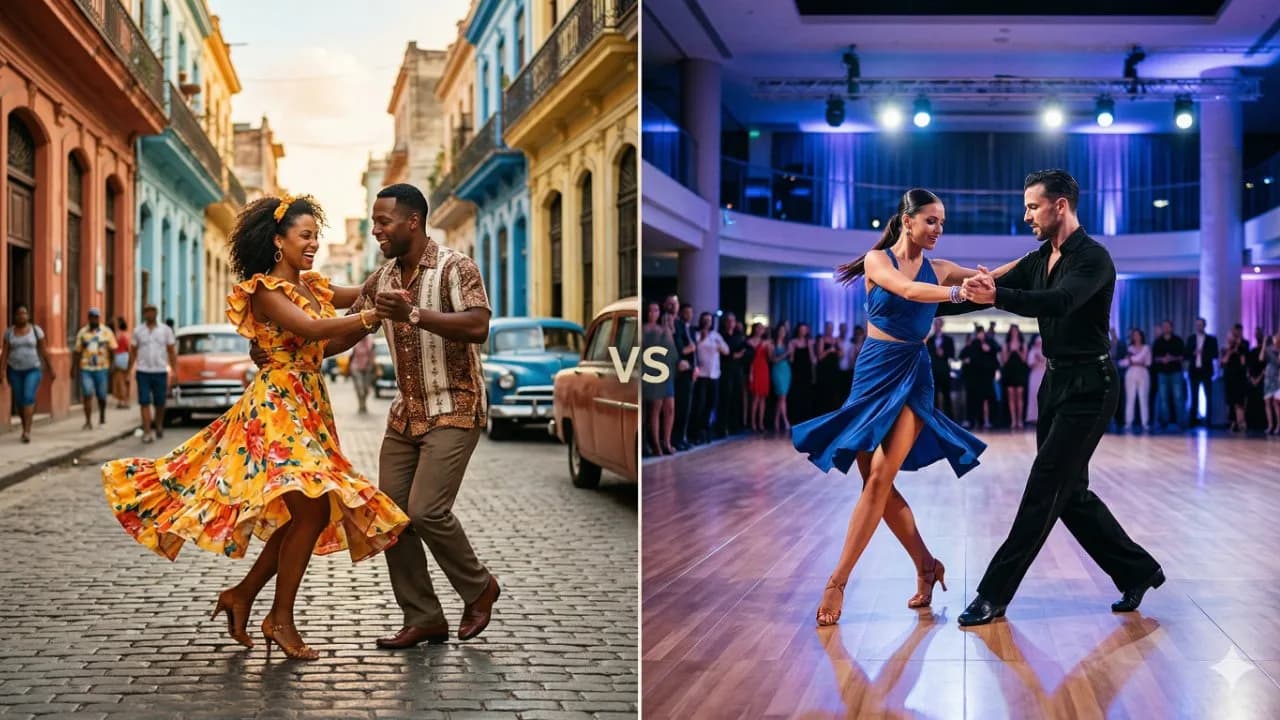
Cuban salsa, simply called Casino in Cuba, is the original salsa style that was born in the streets and living rooms of Havana. It's a dance that comes from everyday life — spontaneous, social, and deeply connected to Cuban culture.
Characteristics of Cuban salsa
- Circular movement: Partners move in circles around each other, not in a line. This gives the dance a fluid, dynamic character.
- Improvisation: There is plenty of room for personal expression. The leader can choose a different direction at any moment, and the follower responds intuitively.
- Connection with the music: In Casino, you don't just dance on the beat — you also respond to the instruments: the conga, the trumpet, the piano riff.
- Rueda de Casino: A unique group form where multiple couples dance in a circle and, on command from the "cantante" (the caller), execute figures and switch partners. This only exists in the Cuban style.
- Afro-Cuban influences: Movements from rumba, son, and other Afro-Cuban dances are woven into Casino.
Origin
Casino emerged in the 1950s in the social clubs of Havana, particularly the famous Casino Deportivo. The name "Casino" doesn't refer to gambling, but to this club where the dance style became popular. It's a dance of the people — everyone in Cuba dances Casino, young and old, on the street, at parties, and in clubs.
What is linear salsa?
Linear salsa is an umbrella term for salsa styles danced on a straight line. The two most well-known variants are On1 (LA style) and On2 (New York style).
On1 — Los Angeles style
- The leader breaks forward on beat 1
- Spectacular, show-oriented movements
- Popular in competitions and on stage
- Strong influence from jazz dance and Hollywood
On2 — New York style (Mambo)
- The leader breaks forward on beat 2
- More emphasis on musicality and the conga beat
- More elegant and subtle than On1
- Strongly connected to New York's mambo tradition
Characteristics of linear salsa
- Linear movement: Partners move back and forth on an imaginary line ("slot").
- Structured patterns: Figures are often fixed and taught in a specific order.
- Show-oriented: Much attention to styling, tricks, and visual impact.
- Universal: Because patterns are standardised, you can dance anywhere in the world with someone who learned the same style.
Comparison table
| Aspect | Cuban Salsa (Casino) | Linear Salsa (On1/On2) |
|---|---|---|
| Movement | Circular | Linear, on a line |
| Origin | Havana, Cuba (1950s) | Los Angeles / New York (1990s) |
| Music | Son, Timba, Cuban Salsa | Salsa Dura, Salsa Romántica |
| Improvisation | Lots — the dance is a conversation | Less — patterns are more fixed |
| Atmosphere | Social, festive, spontaneous | Stylish, polished, showy |
| Group dance | Rueda de Casino (unique!) | Doesn't exist in this style |
| Basic step | Guapea (sideways) | Cross body lead (forward-backward) |
| Connection | Close, lots of body contact | More distance, arm-led |
| Learning curve | Low — fun on the floor fast | Medium — more technique needed |
Which style suits you?
The choice depends on what you're looking for in a dance:
Choose Cuban salsa if you:
- Value fun over perfection
- Enjoy spontaneity and improvisation
- Love dancing in a group (Rueda!)
- Are interested in Cuban culture and music
- Want to get on the dance floor quickly
- Find the social side of dancing most important
Choose linear salsa if you:
- Enjoy structured, technical dance
- Want to perform or compete
- Prefer a polished, sleek style
Why Cubania chose Cuban salsa
At Cubania, we dance Cuban salsa — and it's a deliberate choice. Our founder Eddy Alfonso was born and raised in Havana and has been dancing Casino since childhood. For him, Casino isn't just a dance style — it's a way of life.
Cuban salsa is:
- More accessible — you don't need any dance experience to start
- More social — thanks to Rueda and partner rotation, you meet people quickly
- More authentic — you dance the way they dance in Cuba, with the right music and the right feeling
- More fun — the combination of improvisation, humour, and group dynamics makes every class a party
Try it yourself!
Curious about Cuban salsa? At Cubania, you can always take a free trial class. We teach at two locations:
Den Bosch
- Location: Huis73, Hinthamerstraat 74
- Class days: Monday, Wednesday, and Thursday
The Hague
- Location: Sportcentrum De Blinkerd, Seinpoststraat 150
- Class days: Tuesday and Friday